
Disclaimer

This website publishes free educational articles about desk setup and movement during computer work. It is not medical advice, does not sell medical products or treatments, and does not promise specific results. For personal health questions, consult a licensed professional in your state.

A 10-minute routine at your desk
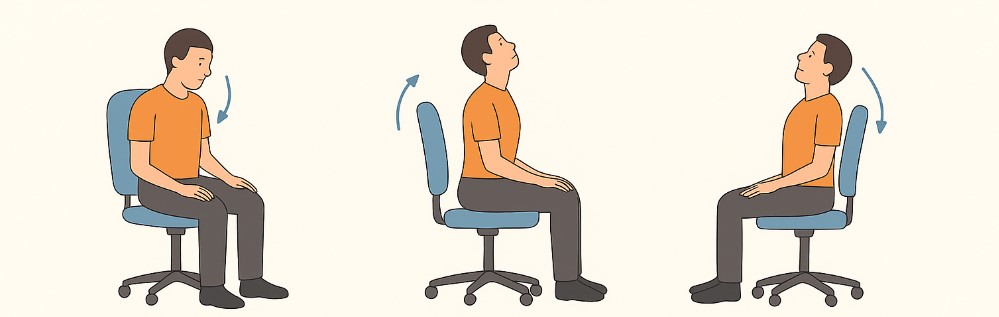
Person performing gentle seated mobility exercises

This routine is built for repeatability. You’ll practice organization first, then gentle mobility. Use a comfortable range—aim for ease, not intensity.

  • Minute 1–3: breathing + ribs over pelvis (3 slow breaths).
  • Minute 3–5: upper-back opening (2 sets of 6–8 slow reps).
  • Minute 5–7: hip mobility (2 sets of 6 reps each side).
  • Minute 7–9: shoulder blades reset (2 sets of 8 reps).
  • Minute 9–10: neck “long” nods (1 set of 6 reps).
Rule of comfort

Stop short of strain. If you feel gripping in the neck or low back, reduce range and return to neutral.

Do it once a day for a week, then choose a schedule you can sustain. Your goal is a predictable posture baseline during work.

Neck and upper back stretches

Desk work encourages the head to drift forward. Instead of forcing the neck back, train “stacking.” The exercises below focus on gentle length and scapular support so your neck doesn’t carry the job alone.

  • Long-nose nods: keep your chin level, imagine the back of your head rising, then nod slightly forward and back (6 reps).
  • Wall-supported reach: sit tall and reach crown upward while exhaling (8 slow reaches).
  • Upper-back opening: interlace fingers behind head lightly and gently open the chest without yanking (6–8 reps).

Pair each movement with a breath. Inhale to prepare, exhale to organize. If a drill feels uncomfortable, shorten the range and slow down. Movement quality matters more than number of reps.

ExerciseReps
Long-nose nods6 slow reps
Chest opening2 x 6–8
Rest10–20 sec between sets

Hip stretches while you sit

Your spine position depends on the pelvis. When hips are stiff, you may “borrow” motion from the low back or end up collapsing your posture. Gentle hip mobility helps you return to a centered seated alignment.

  • Seated figure-4: cross ankle over opposite knee, hinge slightly forward, keep spine long (2 x 6 each side).
  • Posterior pelvic tilt: sit on the front edge slightly, then gently tuck pelvis and release (1–2 x 8–10).
  • Hip flexor set: stand tall, step one foot back, soften front hip, exhale and hold lightly (2 x 20–25 sec).

Notice how your breathing changes during these drills. A helpful sign is feeling your ribcage expand more naturally without gripping the low back.

Fast cue during work

When you notice slouching, do one tiny posterior tilt and then “stack” ribs back over pelvis. This micro-correction is often more effective than holding yourself upright.

Consistency beats intensity. A 2-week routine with gentle mobility is typically easier to sustain than occasional long sessions.

Shoulders and wrists after typing

Many desk strain patterns are actually “support” patterns: shoulders stay elevated during typing, wrists bend in one direction, and forearms tense. These micro-resets help your upper body stay calm.

  • Scapular squeeze: gently pull shoulder blades back and slightly down (8 reps, slow and controlled).
  • Shoulder shrug release: lift shoulders slightly, then drop them fully while exhaling (5 reps).
  • Wrist alignment circles: rotate wrists slowly, keeping forearms supported (6 circles each direction).
  • Forearm shake-out: light shaking with relaxed fingers (15–20 sec).

For best effect, schedule these resets right after you stand up or after you switch tasks. Your nervous system will connect movement with relief, making it easier to return to organized posture later.

Wrists neutral: no constant bend
Shoulders down: not held high
Breathing stays steady
Relax fingers between tasks

How to add more over time

Progression should feel smooth, not forced. Use comfort-based scaling: if the routine feels easy and your posture improves during work, you can add small complexity. If it feels harder than expected, reduce volume and keep the same movements.

  • Week 1–2: keep the routine at 10 minutes, once per day.
  • Week 3: add one extra set to the chest opening or scapular squeeze.
  • Week 4: move one exercise into microbreak format (30–45 seconds during work).

Track one sign: “My neck feels relaxed during focus,” or “I stand up regularly and reset.” When you track, you learn which adjustments are actually helping you.

Reminder

These recommendations are educational. If you have persistent concerns, reassess your setup and seek guidance from a qualified professional.

Want more structure? Browse Events to see community sessions and ergonomic workshops.